
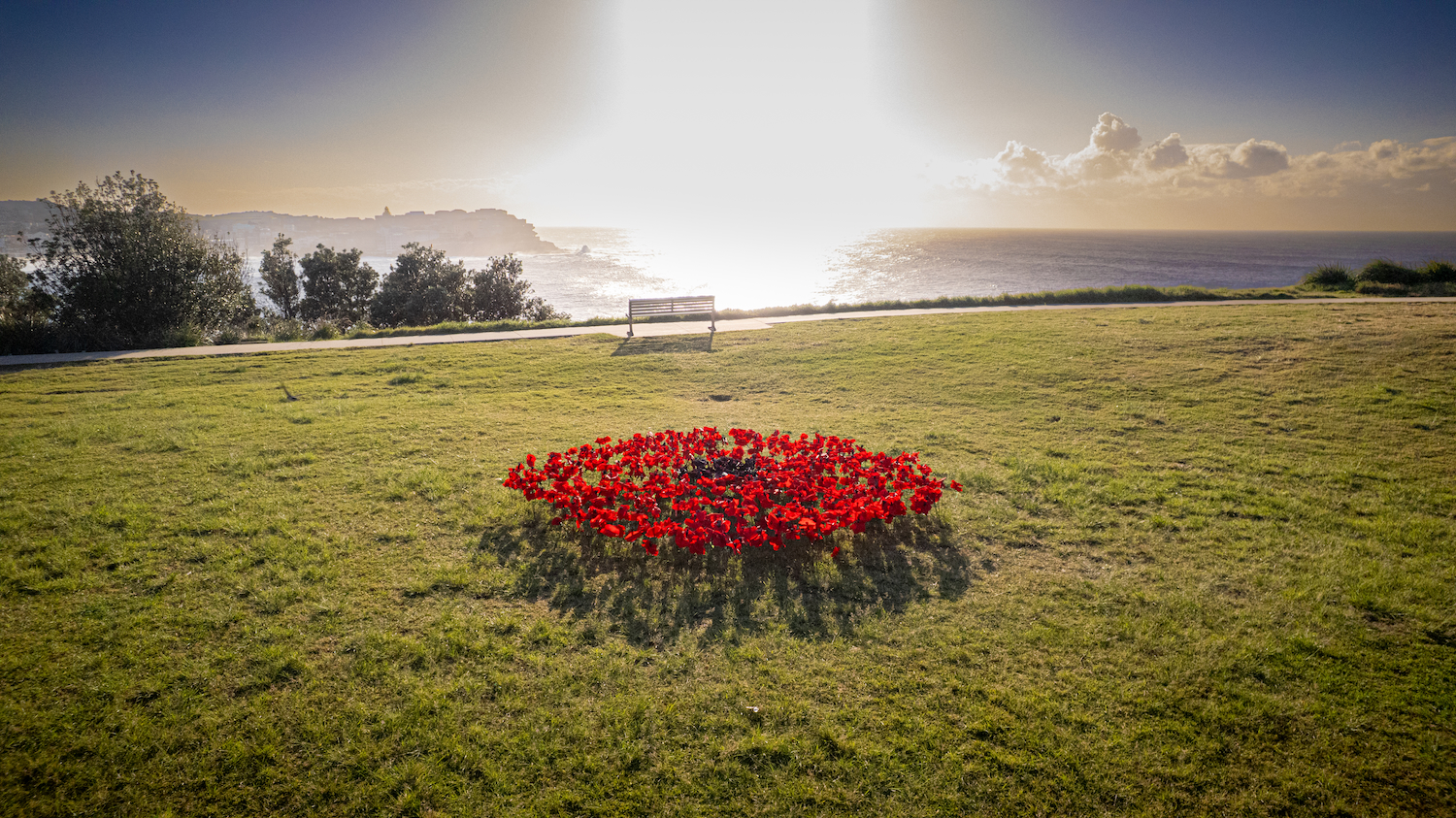
A field of 750 handmade red poppies overlooking Bondi Beach became a striking symbol of remembrance, as Sydney’s Jewish community marked Yom HaZikaron with a project shaped by both Israeli and local tragedy.
Installed before dawn on the cliffs at Marks Park in Bondi, each poppy was folded by hand and placed with care, representing lives lost to terror in Israel and in Australia.

“Each one folded by hand. Each one placed with intention. Each one a name we carry,” organisers said. “Today, we come together to remember those lost to terror, those who fell defending Israel, and those taken from us here in Bondi.”
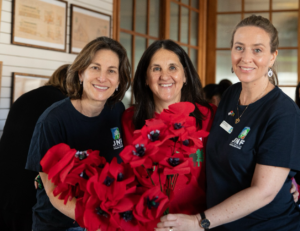
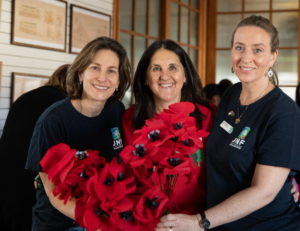
The “Poppy Project” was led by JNF Australia Israel emissary Sarah Vanunu in collaboration with Sydney artist Tracey Hayim. It drew inspiration from Darom Adom, the annual bloom of red anemones in southern Israel, and from the ceramic poppy installations at the Nova festival site in the Re’im Forest following the October 7 attacks.
From the outset, the aim was to move people beyond passive remembrance.
“We wanted to move people from being spectators to participants,” Hayim explained, describing the project as a way to engage physically with memory, grief and connection.
For Hayim, the concept was born during a JNF mission to Israel last year.
“We went to the Nova site (where there is an installation of red ceramic poppies), and I said, ‘It would be so wonderful to be part of this, to make something for our community,’” she said. “I wanted to find a way, as a creative, to give back.”
The idea had already been taking shape before the December 14 terror attack at Bondi Beach but took on deeper resonance in its aftermath.
“We wondered if it was too raw,” Hayim said. “But in the end, it became even more poignant. From Bondi to Israel, from our pain, it just made sense.”
More than 140 volunteers came together for a full-day workshop, producing more than 700 red poppies along with 50 black centres for a four-metre installation. Participants included survivors of the Bondi attack, families, and members of the wider community, Jewish and non-Jewish alike.
Others travelled long distances to take part, including a man who drove from western Sydney with his young daughter to help her connect with her Jewish identity, and an 80-year-old non-Jewish man who simply wanted to contribute.

“There was so much joy in the making,” Hayim said. “People were singing together. It was about humans coming together to feel part of something.”
Hayim, who trained in graphic design in Johannesburg and later built a career in Australia spanning branding, ceramics and community arts, has long focused on projects that bring people together through creative work.
“Art was my solace growing up,” she said. “What I care about is bringing people together to connect through the creative process.”
At dawn, a small group assembled the poppies at Marks Park, creating what organisers described as a physical bridge between grief in Israel and the trauma experienced in Bondi.
As passersby stopped to ask about the installation, conversations revealed that some were unaware of the events of October 7, but were still grappling with the impact of the Bondi attack. The exchanges became moments of shared reflection.
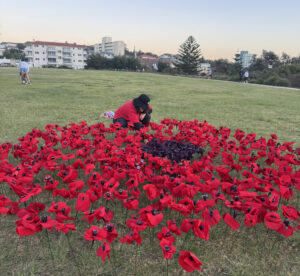
The installation was filmed from the ground and by drone by videographer Darian Krost, with the footage edited and prepared within hours for screening that evening.
The resulting video was shown at the Yom HaZikaron ceremony at Central Synagogue, where JNF Australia partnered with the Zionist Council of NSW and the NSW Jewish Board of Deputies. Organisers said the response was immediate and deeply emotional.
For Vanunu, who was hosting her son’s bar mitzvah at Bondi Pavilion on the night of the attack, the project carried profound personal meaning. As the shooting unfolded, she and her husband found themselves responsible for around 100 children and others who sought refuge, sheltering in place until they were among the last evacuated by police.
“A day of remembering victims of terror is not an abstract concept for many of us anymore,” she said. “Seeing the community come together to make these poppies bloom felt like a vital way to heal and remember.”
Following the installation, the poppies were displayed again at the synagogue during the Yom Hazikaron commemoration. They will be repurposed for community use, including an Anzac Day project.
While the paper flowers are temporary, organisers say the message is intended to endure, with hopes a more permanent installation may be possible in the future.
For those involved, the project has left a lasting impression not only as a tribute but also as a shared act of connection.
Vanunu explains, “There is something deeply healing about using your hands to create beauty out of a story of loss.”