
As Eurovision heads into its 2026 finals in Vienna, Danny Estrin is returning to the contest in a new role, bringing the same Jewish pride and Australian energy that made Voyager’s 2023 performance stand out.
The Voyager frontman walked onto the Liverpool stage with his red keytar, bleached hair and unmistakable energy, leading the Perth band through its synth-metal entry, “Promise”.
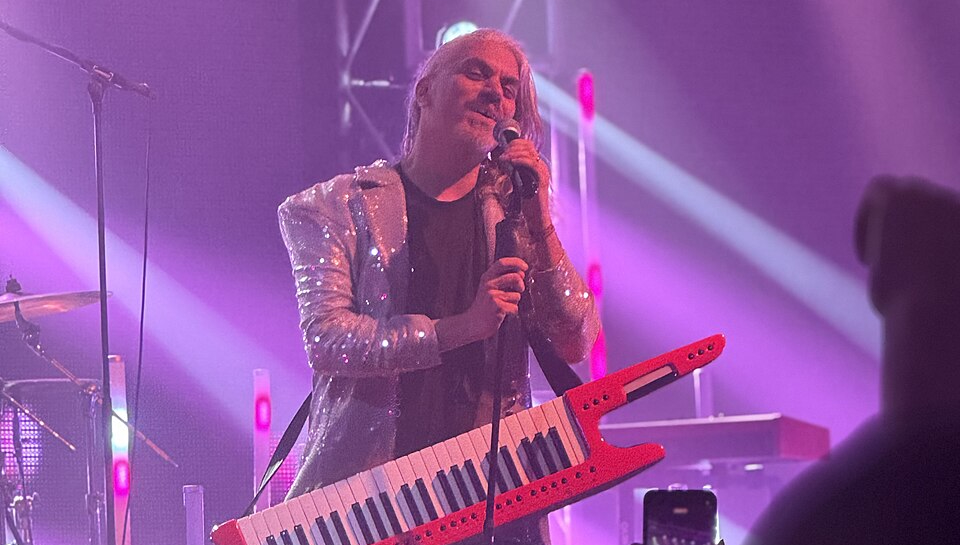
Voyager won the second semi-final with 149 points and finished ninth in the grand final with 151 points. It remains one of Australia’s best Eurovision results and marked the first time a band had represented Australia at the contest.
For Estrin, the performance carried a personal story beyond the spectacle.
He has not presented himself as a religious figure, but he has spoken openly about his Jewish identity and the cultural connection that runs through his life. In a 2023 interview with the Australian Jewish News, he described being “Jew-ish” as a significant part of who he is and spoke warmly about Jewish humour, family memory and the feeling of kinship he has when meeting other Jews.
That background made Voyager’s Eurovision moment more than a strong performance by an Australian act. It placed a Jewish Australian artist on one of the world’s most-watched music stages at a time when public expressions of Jewish identity have carried added weight.

Estrin was born in Germany to a Soviet Jewish family and moved to Perth as a child. Music was part of his life early, with his first piano sent from the Soviet Union by his babushka. He later built two demanding careers, as the lead singer of Voyager and as a migration lawyer in Perth.
Voyager’s road to Eurovision was long. The band had tried to reach the contest for years before SBS selected it to represent Australia in 2023. Its performance mixed heavy guitars, pop hooks and bright theatricality, giving Australia a distinct entry in a field often dominated by solo pop performers and ballads.
Estrin’s Jewish identity is cultural rather than religious. He has credited his father with shaping his understanding of Jewish life and has embraced that inheritance through humour, family and belonging. On the Eurovision stage, it was not worn as a campaign or slogan. It was simply part of the person standing in front of the microphone.
His connection to the contest continued after Liverpool. In 2024, SBS chose him as Australia’s Eurovision jury spokesperson. In 2026, he returned again as part of SBS’s Eurovision coverage from Vienna alongside Courtney Act.
The return followed a difficult period. In September 2023, Estrin revealed he had been diagnosed with cancer and needed immediate treatment, forcing Voyager to cancel a European tour.
For Jewish Australians, Estrin’s story stands out because it is not framed by apology or defence. He reached a global stage through talent, drive and a striking sense of self, while allowing his Jewish background to sit naturally within his public identity.
“Promise” gave Australia a top-10 Eurovision result. It also gave Jewish Australians a rare moment of representation under the contest’s brightest lights.