Tradition revisited: Fiddler on the Roof returns

Few musicals have endured like ‘Fiddler on the Roof’, but its staying power has never relied on nostalgia alone.
Since opening on Broadway in 1964, the story of Tevye and his family has travelled across continents and cultures (it ran for more than 50 years in Japan), returning again and again because its central questions remain unresolved. What does it mean to hold on to tradition in a changing world? What happens when communities are pushed to the edge by forces beyond their control?

Scene from Fiddler on the Roof (Photo: Marc Brenner)
Its reach was cemented by the 1971 film adaptation, shaped by Jerome Robbins’ original choreography, which brought the story to a global audience and fixed moments like the bottle dance in the public imagination.
Most audiences will already know the story, many almost by heart. They know the songs, the characters and the emotional arc. But the latest production argues that familiarity is not the point. Instead, it sets out to make the material feel immediate again, reframing a well-known work for a world that increasingly echoes its themes.
Now, more than 60 years later, the musical returns to Australia with a production carrying significant momentum. Following sold out seasons in London and across the UK, including a run at the Barbican where it became the theatre’s best-selling musical, the revival won three Olivier Awards including Best Musical Revival. It will open at the Theatre Royal Sydney on 31 July 2026 before touring nationally.
The tour continues to Brisbane from October and Melbourne from 31 October at Her Majesty’s Theatre, with further dates, including Perth, to be announced.

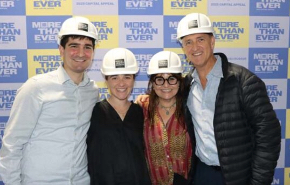
Director Jordan Fein (photo: supplied)
In an exclusive interview with JWire, director Jordan Fein said the musical’s power lies in how directly it reflects the present. “It’s a piece about a community that’s destroyed by political forces beyond their control,” he said. “I just think that reverberates throughout the entire world right now in so many ways.”
Set in the fictional village of Anatevka in 1905, the story follows Tevye, a milkman raising five daughters within a community defined by tradition. As each daughter challenges those traditions, the family is forced to confront change from within, while external pressures build beyond their control.
That tension, between holding on and letting go, sits at the centre of the work’s continued relevance.
Music is part of how that tension is expressed. Songs such as “Tradition”, “If I Were a Rich Man” and “Sunrise, Sunset” are not just performance pieces, but expressions of how the community processes hardship and maintains connection.
Fein, a rapidly rising American theatre director, brings both personal and professional weight to the production. Known for detailed and emotionally grounded staging, he has built a reputation through major work at the Bridge Theatre and the Young Vic.
Raised in a Reform Jewish household in Philadelphia, Fein said his connection to the material is rooted in lived experience. “The culture of Judaism was always really present,” he said, pointing to community and family as central influences.
His approach is not to overhaul the musical but to sharpen its emotional focus. “It’s not some radical reinvention… it is ‘Fiddler’ for a modern audience,” he said. “All of the people on stage… really feel like real people.”
That shift is most evident in his treatment of Tevye’s daughters. “Often they can be seen as one idea,” he said. “But… they’re really individual young women fighting for what they want.”
A key visual change is the expanded presence of the Fiddler, who appears throughout the production. Fein describes him as “the musical tether of the whole piece” and a companion to Tevye as he navigates change. “It’s about how tradition and progress have to exist side by side when one can’t continue without the other.”

Scene from Fiddler on the Roof (Photo: Marc Brenner)
Despite broader updates, some elements remain untouched. The bottle dance is staged exactly as originally choreographed by Robbins. “What you see on our stage is what’s in the film,” Fein said, describing it as “an extraordinary metaphor” at the heart of the work.
For Fein, the musical’s endurance comes down to its universality. It is about family, community and the consequences of division. “It’s a warning… when there’s an us and a them,” he said.
For audiences who feel they already know the show, Fein’s message is simple. “You haven’t seen our ‘Fiddler’.”
What he hopes the production offers is something increasingly rare. A shared experience. “There are so few times in our lives right now where we sit in a room… and we’re all experiencing the same thing,” he said. “I think you’re left feeling connected to other people… and I think we desperately need that right now.”
For more information and bookings, see: https://fiddlerontherooftour.com/