Efforts to end the war between the United States and Iran appear to have stalled as the two sides trade fire in the Gulf, while a US intelligence analysis concluded Tehran could withstand a naval blockade for months.
A CIA assessment indicated Iran would not suffer severe economic pressure from a US blockade of its ports for about another four months, according to a US official familiar with the matter, suggesting US leverage over Tehran remains limited as the two sides seek to end a conflict that has been unpopular with US voters.
The Washington Post first reported the assessment. Recent days have seen the biggest flare-ups in and around the Strait of Hormuz since a ceasefire began a month ago, and the United Arab Emirates came under renewed attack on Friday.
Washington is awaiting Tehran’s response to a US proposal that would formally end the war before talks on more contentious issues, including Iran’s nuclear program.
“We should know something today,” US Secretary of State Marco Rubio told reporters in Rome earlier in the day.
“We’re expecting a response from them.”
Iran’s foreign ministry spokesperson said Tehran was still weighing its response, and none had been reported by mid-afternoon in Washington, just before midnight in Tehran.
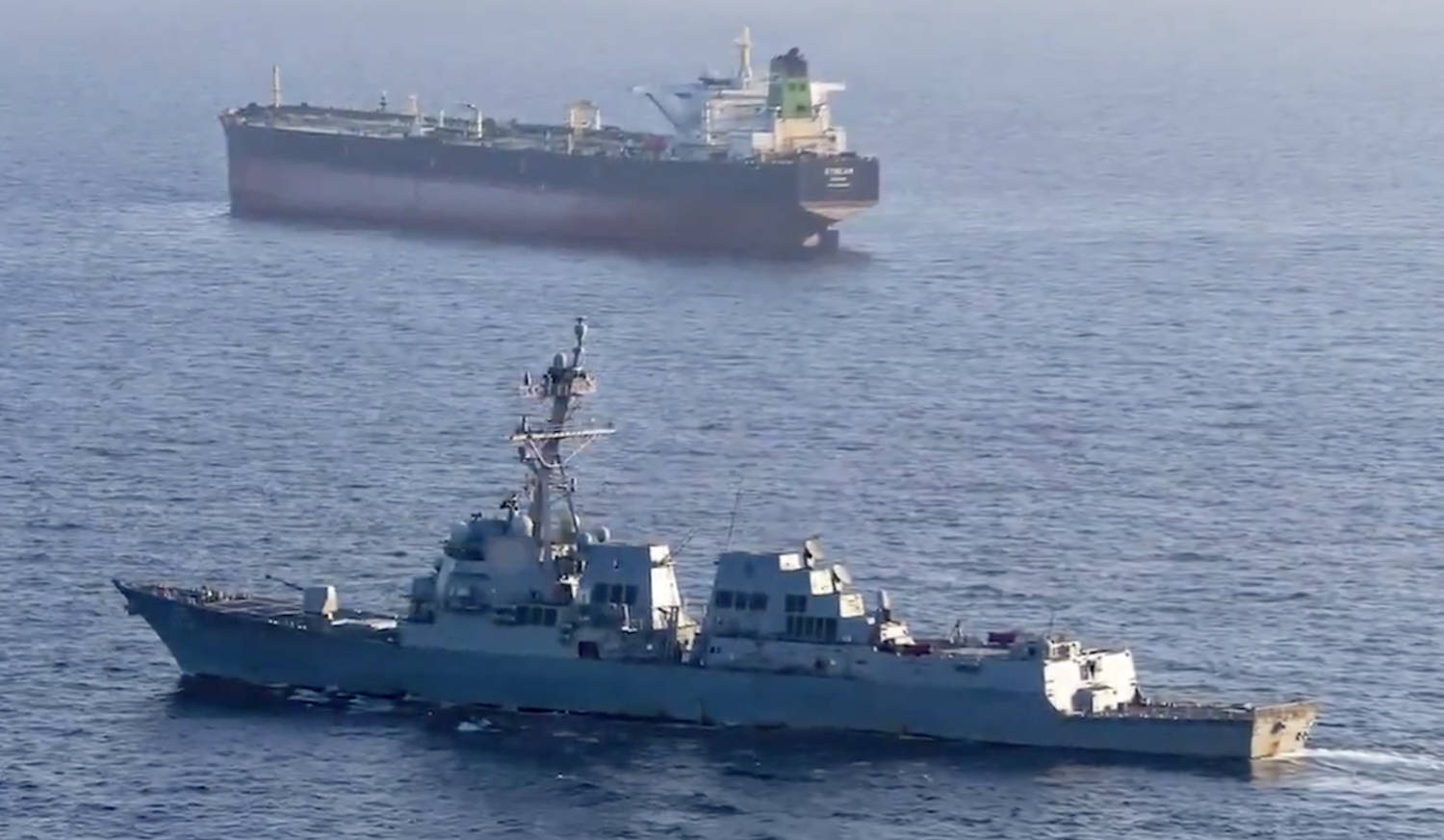
US Navy ship and tanker near the Strait of Hormuz. (X.com)
Meanwhile, sporadic clashes between Iranian forces and US vessels took place in the Strait of Hormuz, Iran’s semi-official Fars news agency reported. The Tasnim news agency later cited an Iranian military source as saying the situation had calmed, while warning that more clashes were possible.
The US military said it struck two Iran-linked vessels attempting to enter an Iranian port, with a US fighter jet hitting their smokestacks and forcing them to turn back.
Israel remains a central player in the conflict, having launched the joint US-Israeli airstrikes on Iran on February 28 that triggered the current war. The strikes targeted Iranian military and nuclear facilities and were aimed at curbing Tehran’s nuclear ambitions and its support for regional proxy groups including Hezbollah and Hamas. Although the latest diplomatic efforts are being led by Washington and Tehran, Israel’s security concerns continue to shape the broader context of the negotiations.
Israeli leaders have made clear that any agreement must prevent Iran from advancing its nuclear program or rearming its regional allies. Photographs displayed in Tehran this week of victims of the US-Israeli airstrikes underscored the enduring role of Israel in a conflict that has redrawn strategic calculations across the Middle East.
Iran has largely blocked non-Iranian shipping through the strait since the war began with joint US-Israeli airstrikes across Iran on February 28.
The US imposed a blockade on Iranian vessels last month. Oil prices rose, with Brent crude futures above US$101 (A$139) a barrel, although still down more than six per cent for the week.
Donald Trump said on Thursday the ceasefire was still holding despite the flare-ups in the strait, which before the war handled one-fifth of the world’s oil supply.
The confrontation extended beyond the waterway. The United Arab Emirates said its air defences engaged two ballistic missiles and three drones launched from Iran on Friday, with three people sustaining moderate injuries.
During the war, Iran has repeatedly targeted the UAE and other Gulf states that host US military bases. In what the UAE called a “major escalation”, Iran stepped up attacks this week after Trump announced “Project Freedom” to escort ships through the strait before pausing it after 48 hours.
Iran accused the US of breaching the ceasefire, which had largely held since it was announced on April 7 but has come under strain this week after Trump announced, and then paused, a naval mission to reopen the strait.
“Every time a diplomatic solution is on the table, the US opts for a reckless military adventure,” Araqchi said on Friday.
Iran’s Mehr news agency reported that one crew member was killed, 10 were wounded and four were missing after a US Navy attack on an Iranian commercial ship late on Thursday.
Rubio, after meeting with Italian Prime Minister Giorgia Meloni, questioned why Italy and other allies were not backing Washington’s efforts to reopen the strait.
“Are you going to normalise a country claiming to control an international waterway? Because if you normalise that, you’ve set a precedent that’s going to get repeated in a dozen other places,” he said.