
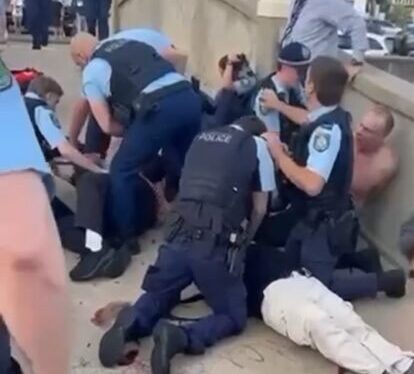
Public Jewish life in Australia is set to operate under heightened security as the Royal Commission on Antisemitism and Social Cohesion calls for nationwide changes following the Bondi terror attack, warning that festivals such as Chanukah will continue to be high-risk targets.
The Commission’s Interim Report, presented on 30 April to the Governor-General Sam Mostyn, sets out 14 recommendations, five of which are contained only in the confidential version for national security reasons.
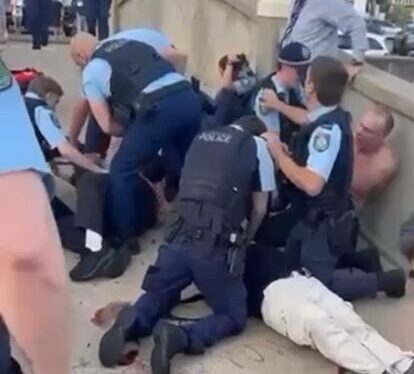
The report follows the 14 December 2025 attack at Bondi Beach, where 15 people were killed and 40 injured during a Chanukah event attended by hundreds of community members.
Among the key recommendations are increased security at Jewish events and festivals, a review of Australia’s joint counter-terrorism network, and renewed efforts to implement nationally consistent gun laws.
The report calls for a review of Joint Counter-Terrorism Teams, including leadership structures, team integration, systems access and information sharing arrangements, with particular focus on NSW.
It also urges governments to prioritise the rollout of a nationally consistent firearms framework and gun buyback scheme.
Commissioner Virginia Bell said the inquiry had identified areas where Australia’s counter-terrorism capability could be improved but found no urgent deficiencies requiring immediate action.
“Our inquiry revealed some respects in which counter-terrorism capability at Commonwealth and state levels might be improved,” she said.
The report makes clear that the issue was not a failure of law.
“No material or advice from any agency identified any gap in the existing legal and regulatory frameworks that impeded the ability… to prevent, or respond to, an attack of the kind that occurred,” the report states.
It adds that no intelligence or law enforcement agency indicated it had been prevented from taking action under the existing legal framework.
Instead, the findings point to challenges in coordination, information sharing and operational decision-making across agencies.
For the Jewish community, the implications are immediate. The report highlights that Chanukah is widely celebrated in Australia through public events in parks and open spaces, with menorah lightings and large gatherings that increase exposure.
At the Bondi “Chanukah by the Sea” event, organisers expected around 1,000 attendees at a public celebration featuring food stalls, children’s activities and a menorah lighting.
Security planning had already identified the risks. The Community Security Group assessed the threat level as “high” and warned that a terrorist attack against the Jewish community was likely amid escalating antisemitic hostility.
The Commission notes that crowded public events linked to identity or religion remain among the most likely targets for attack, particularly from lone actors or small groups using simple methods.
Among its recommendations is that NSW Police procedures used during Operation Jewish High Holy Days be extended to other high-risk Jewish festivals and events, especially those with a public-facing element.
The report is set against a deteriorating threat environment. Australia’s terrorism threat level had been raised to “probable” in August 2024 and remained there through 2025, while antisemitic incidents escalated from harassment to the direct targeting of Jewish people, institutions and public events.
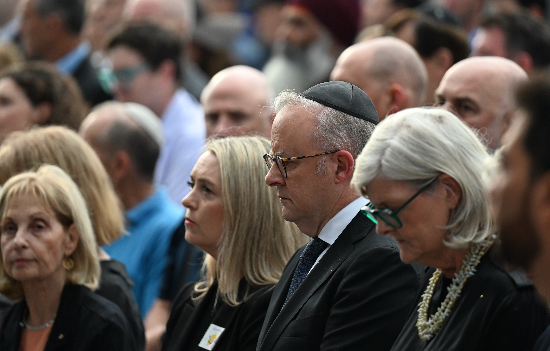
Responding to the report, Prime Minister Anthony Albanese said the government would implement all recommendations within its remit and work with states and territories on a coordinated national approach.
“A number of the recommendations relate to state and territory jurisdictions… we’ll work constructively with state and territory governments on those issues,” he said.
He confirmed that five recommendations remain classified and defended the government’s response following the Bondi attack.
“In the wake of the Bondi attack, my government took immediate action to bolster the resources of our security agencies, tackle antisemitism, crack down on hate preachers and deliver tougher gun laws,” he said.
Governor-General Mostyn acknowledged the significance of the report, saying she looked forward to receiving the final findings later this year.
The report also notes ongoing criminal proceedings arising from the attack. An accused remains before the courts facing terrorism and multiple murder charges.
For the Jewish community, the findings reinforce a lasting shift. Public celebrations such as Chanukah are expected to require sustained security coordination, intelligence awareness and visible police presence.
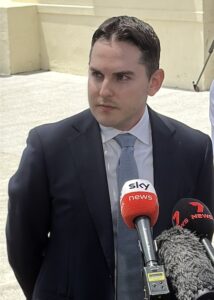
NSW Jewish Board of Deputies president David Ossip said the findings confirmed the reality facing Jewish Australians.
“The findings confirm what our community has been saying for some time – that antisemitism in Australia has escalated significantly in both frequency and severity, and that Jewish Australians have increasingly been targeted not just with words, but with violence,” he said.
He said the report’s conclusion that no legal gaps existed shifted attention to how systems functioned in practice.
“This places a necessary and important focus on how systems, coordination, prioritisation and operational decision-making functioned in practice.”
Ossip welcomed the recommendation to extend high-level security arrangements to major Jewish events but stressed the broader challenge.
“Antisemitism did not begin on 14 December and is not only a law enforcement issue – it is a societal issue.”
Submissions to the Commission are open until the end of May, 2026. Public hearings will begin in Sydney from 4 May to 15 May, examining the lived experiences of Jewish Australians and the broader drivers of antisemitism as the inquiry moves into its next phase.
With AAP