
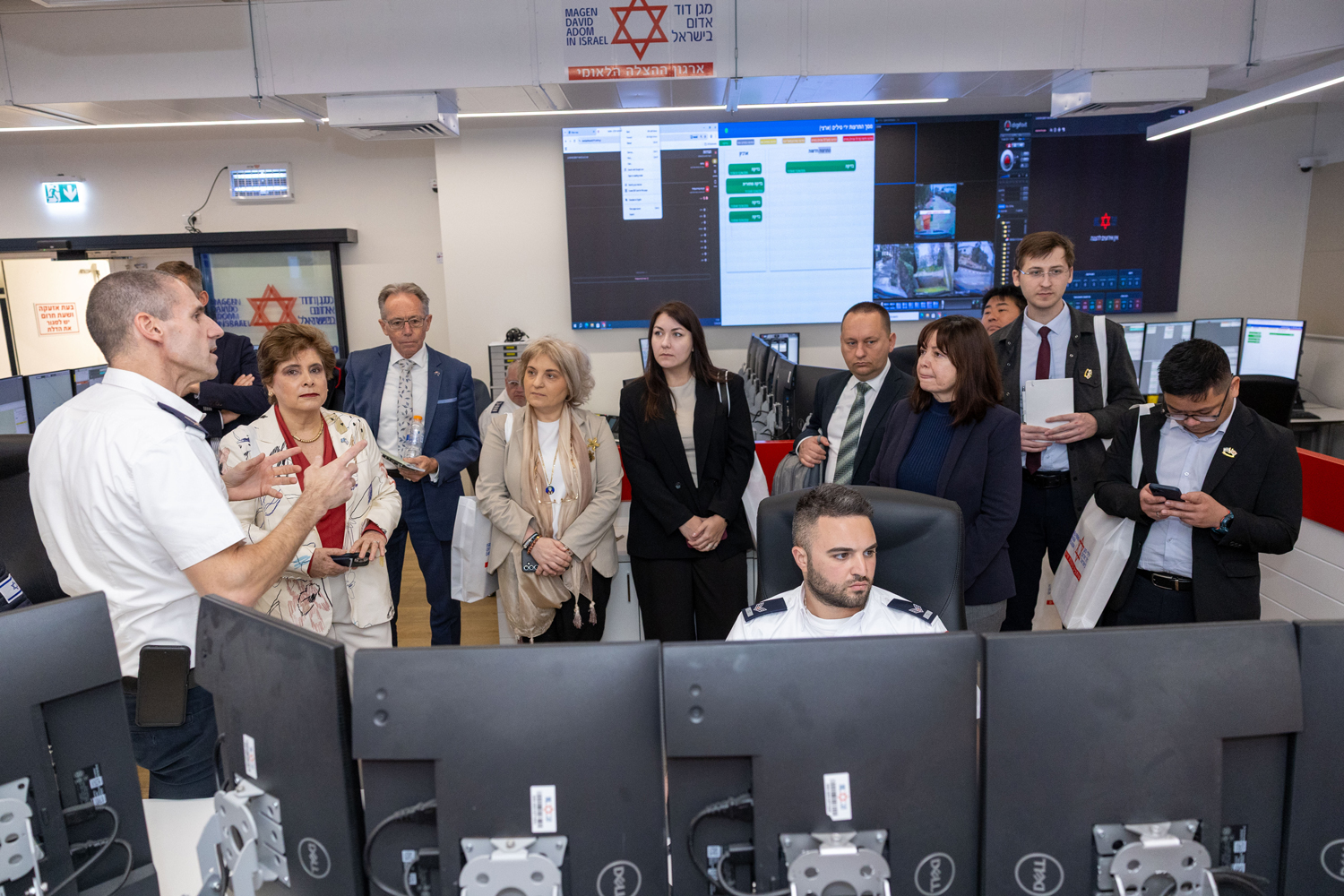
Australia’s ambassador to Israel, Neil Hawkins, was a member of a delegation of ambassadors and senior diplomatic representatives who toured Magen David Adom’s national headquarters in Ramla, in a visit aimed at gaining a closer understanding of Israel’s emergency medical system and its role in national resilience.
Envoys briefed on Israel’s emergency backbone
The delegation, hosted in cooperation with the Ministry of Foreign Affairs and the Ambassadors’ Club in Israel, included dozens of envoys from around the world. They were received by the Foreign Ministry’s Chief of Protocol Gil Haskel, Ambassadors’ Club President Yitzhak Eldan, and MDA Global President Ambassador Gilad Erdan, a former Israeli ambassador to the UN and the United States.
During the visit, the diplomats were given an overview of Magen David Adom’s work in both routine and crisis, its function as Israel’s national emergency medical service, and its nationwide deployment—from major urban centres to remote communities. Briefers stressed MDA’s mandate to provide rapid, high‑quality care to every citizen and its close operational integration with the IDF, Israel Police and Fire and Rescue Services, making MDA a core component of the country’s overall emergency response.
Inside MDA’s command and control system
The group was shown MDA’s advanced command and control capabilities, including the 101 National Emergency Dispatch Centre, described as one of the leading systems of its kind worldwide. The system, developed together with paramedics and dispatchers, incorporates real‑time location data, analytics and decision‑support tools, allowing staff to manage thousands of incidents at once and dispatch resources within seconds.
Officials also presented MDA’s operational fleet: thousands of ambulances and mobile intensive care units, hundreds of emergency medicycles and rapid‑response vehicles, and tens of thousands of volunteers across the country. The organization’s blood services, which maintain blood supplies for the entire health system in both routine and emergency, were highlighted as another critical pillar. Taken together, these assets are designed to support a fast, professional response even in mass‑casualty incidents and wartime conditions.
“One of the pillars of national resilience”
Ambassador Gilad Erdan, Global President of MDA, said the visit underscored the organisation’s broader role beyond frontline medicine. He described Magen David Adom as “one of the central pillars of Israel’s national resilience,” noting that its teams are responsible for emergency medical response “everywhere in the country,” with a commitment that “every citizen receives a fast, high‑quality response, wherever they are.”
Referring to the period since the October 7 attacks, Erdan said Israel’s home front has been living under “persistent threat,” making the ability to respond “quickly, accurately and on a large scale” a vital national requirement. He stressed that hostile actors “deliberately target civilians,” and argued that the resilience of the home front underpins the endurance of the front line. MDA, he said, embodies a simple promise: that every life matters, no one is abandoned, and help will always come.
Gil Weiser, Chairman of the Israeli Friends of MDA, called it “a great honour” to host the diplomatic corps and showcase the national command and control system, which he described as the “operational heart” of Israel’s emergency response.
Weiser outlined three main axes of MDA’s work around the system: the real‑time technology itself; a broad training network that in the past year alone has trained more than half a million civilians through roughly 1,000 instructors; and the organisation’s life‑saving know‑how, including the deployment of smart, networked defibrillators in the field. He said MDA is now working to export these capabilities, share expertise and build partnerships with other countries, on the assumption that Israeli experience and home‑grown technology can help save lives well beyond Israel’s borders.
Diplomats praise professionalism and cooperation
MDA Director General Eli Bin said the organisation was proud to host representatives of the international community and to demonstrate how a nationwide emergency service operates around the clock.
He emphasised that MDA works in a “complex and dynamic” environment that demands constant readiness, rapid decision‑making and an ability to deliver a fast, accurate and equitable response “to every citizen, anywhere, at any time.” Those capabilities, he said, rest on a combination of committed professionals and volunteers, decades of accumulated operational experience and cutting‑edge technology centred on the national command and control system.
According to MDA, the visiting ambassadors expressed strong appreciation for what they described as a high level of professionalism, exceptional dedication among staff and volunteers, and advanced operational and technological tools that together form a distinctive model for emergency medical services worldwide. Bin thanked the envoys for their interest, open discussion and willingness to deepen international cooperation “based on a shared commitment to saving lives.”