

Carmel Reunion

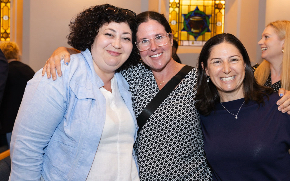
I have just returned from a very moving and memorable reunion of pupils of the Jewish Boarding school Carmel College my father founded in 1948 until it closed in 1997.

Jeremy Rosen
It was often called the Jewish Eton. Those who attended ranged from its very first year to its last. I experienced Carmel as a naughty pupil, and years later as its headmaster and principal. We all agreed that Carmel had a profound impact on our lives in one way or another.
The reunion included a debate in which I participated “That Carmel College was a failed Jewish educational experiment.” The motion was overwhelmingly defeated because nearly everyone there looked back on their Carmel experience with affection and gratitude, even if some did not at the time!
But the question was whether Carmel could be considered a model for Jewish education or whether it was just a unique child of its time.
When my father started Carmel College in 1948, it was at a time when the British Empire still existed, and Britain was a haven for refugees escaping the horrors of European Jew hatred. But even in Britain, antisemitism was manifest and this encouraged many Jews to assimilate or hide their identities. The idea of Jewish education horrified many as segregation and an impediment to integration. Opposition to the project was fierce. My father argued that Jewish students in non-Jewish schools would always feel like outsiders. In Carmel, they would have the confidence of being insiders and better adjusted when eventually they did go out into the world.
My father persevered and Carmel grew under his charismatic leadership. Its success looked like an example of how to educate young jews to be confident in their identity, academically successful, and familiar with Judaism and its rituals. The beauty of its campus and its riverside location were among its greatest attractions. If it modelled itself on the great English Public Schools (without their deficiencies), the warm Jewish dimension and my father’s religious charisma distinguished itself from other schools. Carmel was a success in so many other areas, music, art, drama, and sport, as well as academic, where very bright students went to the very best universities.
But my father’s intentions for the school were very different to the school that emerged. Originally, he hoped there would be a balance between the Jewish and the secular. But the Jewish side was always the orphan. Jewish teachers were less academic though they compensated by offering hospitality and warmth. Most of the pupils came from homes that were not religious and didn’t care for a Jewish education. Many parents effectively undermined the Jewish ethos.
There were a few who came from religious backgrounds who did care, and those who wanted to, could find teachers on the campus to help them thrive both religiously and in Jewish studies. But for the majority, it was difficult having to keep Shabbat and Kashrut. My father was a tolerant, open-minded man, and he came to accept the reality, but he gloried in those few who went on to become rabbis and scholars.
Carmel was always a very expensive option. Its financial burden all the greater because it had to fund the extra Jewish curriculum and because it offered so many scholarships and reductions. And because it was independent and was not seen as part of the community, it was always a problem to raise funds.
In the last days of his life, my father, who was a passionate, religious Zionist and convinced of Israel’s future, had already made plans for the future by establishing a Carmel school in Israel. With the help of Nachum Goldman, the head of the World Jewish Congress, he acquired land in Zichron Yaakov and produced a prospectus. Unfortunately, his premature death at the age of 48 in 1962 put paid to the scheme. Carmel carried on after his death until it closed in 1997.
But its history does raise the issue of whether it was the ideal form of Jewish education. Jewish education in the diaspora has exploded since those days, primarily in the form of day schools from across the whole spectrum of Jewish life. Jewish schools that cater for the wider community meet a social need but are usually not that successful in producing religiously committed young men and women. And it can often have a negative effect. Yet there are examples, mainly in the USA, where excellence in both areas proves that, at least, it is possible to get the best of both worlds.
There is much debate as to whether Jewish schools that cater for a very wide range of pupils should be spending more time teaching non-religious subjects like Jewish history, to give young men and women the tools to fight back against anti-Semitism and have a sense of where they come from. In Israel, of course, there are different issues. From the start of the State of Israel, religious and secular provided opposing cultures. But today, there are many more schools that try to offer both.
The Carmel example was successful in bringing young Jewish boys (and then at a later stage girls), from all different backgrounds, countries and cultures together in one educational space, where they could also taste a Jewish life, something that most of them did not see at home.
There have been examples of trying to replicate Carmel in the diaspora, most notably the American Hebrew Academy in North Carolina. It opened in 2001 with outstanding facilities and a Carmel-like campus. But its non-denominational culture failed to satisfy either side, and boarding at an early age was not popular. It struggled to attract students, and in 2019, it closed.
There is no perfect solution to the challenge of Jewish education. We continue to struggle with the issues of how to pass on our Jewish identity to the next generation. But it’s becoming clearer that the pressures of society and peer groups challenge religious observance. It is the home that is the most determining factor of whether someone will live a Jewish life or not, although even then, there are no guarantees.
The only area in Jewish life where there is exponential growth is in the Charedi world, and even then, there are dropouts. No guarantees. And, sadly, as a reaction to Jew hatred, many are finding their way back to the Jewish world. Perhaps most importantly, other tools for Jewish survival did not exist fifty years ago, from Jewish evangelicals to organised visits to Israel.
There are no golden bullets. Whatever works. So, to end with an example of Athens and Jerusalem, Shakespeare said, “Good wombs have borne bad sons” (The Tempest Act 1, Scene 2). But the Mishna says, “You do not have to finish the work, but neither can you give up” (Ethics Chapter 2.21).
Rabbi Jeremy Rosen lives in New York. He was born in Manchester. His writings are concerned with religion, culture, history and current affairs – anything he finds interesting or relevant. They are designed to entertain and to stimulate. Disagreement is always welcome.





Thank you Glenn and kudos to you for all you did in the cause!
A most fitting tribute to Carmel Academy, it’s alumni, your father’s legacy and your life’s work. The work of Jewish educators and their students is never in vain despite the critics, naysayers, and the difficulties to have been overcome as well as those yet conquered. Kol Hakavod for furthering the dream and keeping memories sustained.
Beautifully written……from beyond the beyond, a proud fathers son.