
While most Jewish Australians hold a strong attachment to the state of Israel, opinions on the government and its policies vary greatly, an inquiry has heard.
Jewish Australians should not be held accountable for the actions of the Israeli government, despite most holding a strong attachment to the country itself, the inquiry was told.
Peter Wertheim speaks to the Royal Commission
Members of Australia’s Jewish population were shocked by the response to the October 7, 2023 attack by Hamas on Israel, including a large pro-Palestinian rally outside the Sydney Opera House where antisemitic slurs were used.
The Royal Commission on Antisemitism and Social Cohesion on Tuesday heard further evidence about the lived experiences of Jewish Australians.
Prominent advocate Peter Wertheim said there is a great deal of sympathy for Palestinians within the Jewish community, which was not reciprocated following the October 7 attack.
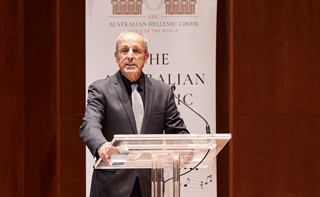
“This was an attack that had been initiated by Hamas,” said Mr Wertheim, who is co-chief executive of peak body the Executive Council of Australian Jewry.
“They had done it in the most appalling way.
“There was no sympathy expressed for those who were at the receiving end of that treatment.”
The October 7 attacks, in which about 1,200 people were killed and another 250 taken hostage, marked a significant turning point for antisemitism in Australia, counsel assisting the commission, Zelie Heger earlier told the inquiry.
Israel’s subsequent military campaign in Gaza has killed more than 70,000 people in the Palestinian enclave and has been labelled a genocide by a United Nations commission, which the Israeli government disputes.
Vic Alhadeff OAM, a non-executive director at public broadcaster SBS, told the inquiry that “so much of the manifestation of antisemitic incidents and attacks is interlaced with, and references, what is taking place on the other side of the world”.
In response to his concerns about rising antisemitism, Dr Alhadeff said a representative from another faith group told him, “but look what’s happening to the Palestinians in Gaza.”
‘My response was, ‘you have to be made of stone not to care about what is happening to the Palestinians in Gaza, however, why are you holding me responsible?”‘ Dr Alhadeff said.
“Jewish Australians have no agency in what the Israel Defence Force does, or, indeed, what the Israeli government does.”
Former High Court judge Virginia Bell, who is heading the commission, asked Mr Wertheim whether, in his experience, Jewish Australians have an emotional attachment to the idea of Israel.
“Very much so,” Mr Wertheim replied.
“Most Jews in Australia have family in Israel and friends, and of course, the Hebrew language and our culture and our religion and our civilisation and values all come from Israel.”
However, while that attachment is constant, opinions on various governments and policies have varied greatly in Australia, as they have in Israel, he said.
Jeremy Stowe-Lindner, principal of Melbourne’s Bialik College, which he describes as a Zionist school, compared Zionism to being a patriotic Australian in that it does not involve affiliation to a particular political party or policy.
“Zionism is not a particular political belief. It is not a support for any government or coalition within Israel,” he told the inquiry.
“It’s simply the belief that Israel, as a homeland for the Jewish people, has a right to exist.”
Mr Stowe-Lindner said that since late 2023 his school had seen an “avalanche” of antisemitic incidents, including graffiti, verbal slurs and students being spat on.
“We can’t go into the CBD in Melbourne anymore in school uniform because of what we’ll face,” he said.
He agreed the catalyst appeared to be Jewish people, including children, being identified with the policies of the Israeli government.
The commission will hand down a final report before the end of the year.
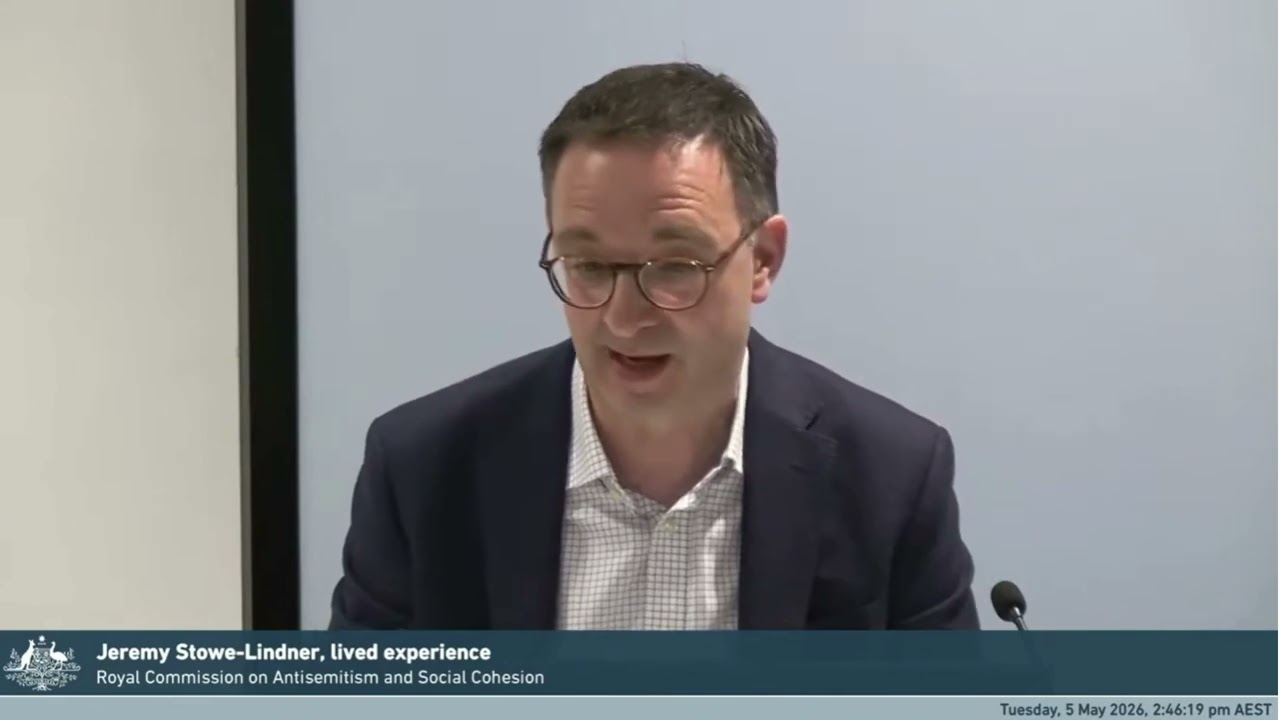
Bialik Principal, Jeremy Stowe-Lindner
By: Duncan Murray/AAP