A different Chanukah

When we talk about being Jewish, we become aware the very term is ambiguous and ill-defined.

Jeremy Rosen
Are we a people, a nation, a religion, ethnicity, the Children of Israel, Hebrews, Judeans or Jews? Pious, God-fearing, atheists, secular, or just accidents of birth and more loyal to countries of adoption than one’s origins?
Both what we call ourselves and the way others call us, have changed over the past 3000 years or more. Throughout our history, from the very beginning, we have been divisive, belligerent and stiff-necked. Betrayers of our mission and traditions and easily seduced. We may be embarrassed by our rival ideologies, protests, clashes, and national goals. But who are we?
There are fundamental concepts in Judaism of Ahavat Yisrael, Love for Others, Arevim Ze LaZeh. Responsibility of each one of us for the other. We have seen the worst of us these past three years and we have seen the best of us, rallying round, unbelievable self-sacrifice, charity, support and sympathy. We are such a confused dysfunctional people.
Some of us regard ourselves as religious in the sense that, to some extent or another, we follow what I would like to call the constitution of the Jewish people. By which I mean the Torah, both its written form and its oral form. Yet even within the religion we have always been arguing and fighting over what is the right way, or what constitutes being a religious person. And corruption is as endemic now as it was during the era of the great Biblical prophets.
Numerically it’s clear that most Jews are not religious at all, or only very rarely. We are constantly losing significant numbers to assimilation, and we are barely holding our own numerically. Within the religious structure there are so many rival sects, interpretations and ideologies from extreme fundamentalism to extreme assimilation. We have Jews that identify with each other because of their countries of origin, who identify with each other because of which Chasidic dynasty they belong to, who belong to movements whether they are Zionist, nationalist, secular. And we are all constantly being influenced by whichever dominant culture we grow up in or which local culture prevails.
There are so many ways of being religious and degrees of obedience to laws. For some religion is rational and for others it is mystical. We have as many denominations within our few million as others have within their hundreds of millions. And of course, the many who have no religious affiliation at all. How is it that we managed to survive? This seems to me to be the biggest miracle of the Jewish people and in fact this is what we celebrate on Chanukah.
It is not just the lights. But this prayer. Three times a day during Chanukah (four on Shabbat) we repeat our gratitude for our survival.
“We thank you for the miracles, the redemptions, the salvations and the victories that You have performed for our ancestors in those days and now. In Your great compassion, You stood by them in their times of distress, championed their cause, judged their claim, avenged their wrong. You have delivered the strong into the hands of the weak, the many into the hands of the few, the wicked into the hands of the righteous, the arrogant in turn to the hands of those who are engaged in Torah, and you have performed great salvation and redemption and you continue to this very day.”
Historians will argue about the Maccabee revolt. Whether it was such a great victory or not. Whether external factors enabled Judah and his brothers to assert Jewish independence or not. In whichever way we may understand the Maccabean revolt (2,200 years ago) and the divisions within the people at that time, the religious, social, and political, we cannot but be amazed at how we survived or how similar it is today.
Whether the victory was a victory of circumstances or of arms or of good fortune or divisions within our enemies, the fact is that somehow or other we managed to survive. And that alone is the greatest cause for gratitude and for confidence that we can have. Not without our losses, tragedies and agonies. We have defied the odds in the past and we do now, whether we deserve it or not.
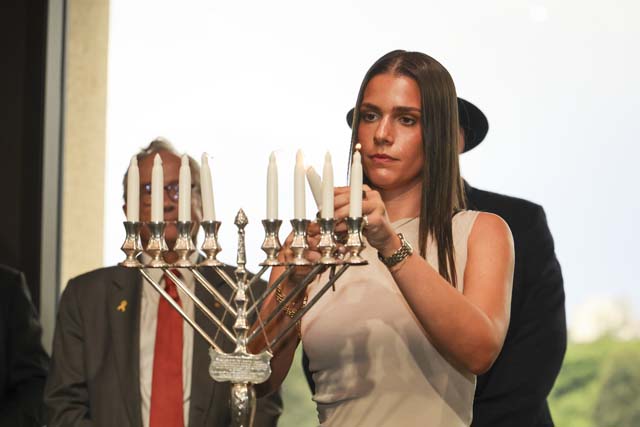
We should light our lights in public view so that we can show ourselves to the outside, so that everybody can see our fortitude. Some place the flags of Israel that proclaim our commitment, even at the risk of provoking a reaction. We should not be afraid. The lights of Chanukah invite us to celebrate and stand proud whoever we are.
Rabbi Jeremy Rosen lives in New York. He was born in Manchester. His writings are concerned with religion, culture, history and current affairs – anything he finds interesting or relevant. They are designed to entertain and to stimulate. Disagreement is always welcome.