The forgotten exodus: Sydney honours 850,000 Jews who fled Arab lands and Iran

More than 200 people gathered at the National Council of Jewish Women hall in Woollahra on Sunday evening for the annual commemoration honouring Jewish refugees from Arab lands and Iran.
The commemoration highlighted the long-overlooked story of the 850,000 Jews forced from Arab countries and Iran in the mid-twentieth century. Their departure reshaped the Jewish world and transformed the demographic makeup of the Middle East and North Africa.

Helene Cadry talks about her family history in Iran photo: Giselle Haber
The Board first held the formal commemoration in 2015, after a similar gathering was run independently by Dr Racheline Barda in 2014. Sunday’s event was run jointly by the NSW Jewish Board of Deputies, NCJWA, the Sydney Jewish Museum, Sephardi Mizrahi Voices Australia, and Sephardi Synagogue.
Sydney is widely believed to have been the first diaspora community to host such an event after Israel set the official date in 2014.
This year’s Sydney event focused on Iranian Jewry, whose community fell from about 150,000 to roughly 10,000 following the 1979 Islamic Revolution. Attendees heard from members of the local Iranian Jewish community, who shared family accounts of persecution, escape and rebuilding life in Australia.
NSW Jewish Board of Deputies CEO Michele Goldman told the gathering the evening recognised Sephardi and Mizrahi Jews whose histories include persecution, displacement and remarkable resilience.
“We are not only acknowledging their struggles. We are celebrating the culture, traditions and stories they carried with them. These contributions have strengthened the Australian Jewish community and our shared identity,” she said.

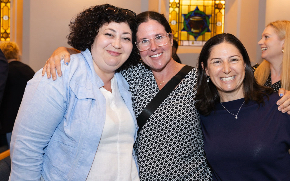
Noha Tsor, Emma Tick-Raker, Janine Joseph at the event Photo: Giselle Haber
Event organisers highlighted that while Palestinian refugees are widely known, far fewer Australians are aware of the Jewish refugees from the same regional conflicts, who were at least as numerous and equally in need of recognition.
Sydney scholar Dr Myer Samra estimates there are about 5000 to 6000 Sephardi and Mizrahi Jews in Australia.
Organising committee member Ariel Weininger said Mizrahi history remained central to the Jewish story.
“It reminds us how diverse and widespread our community is. My family, who spent centuries in Iran and later Egypt and Jerusalem, have stories of resilience and community. That part of me shapes who I am as an Australian,” he said.

Ariel Weininger talks about his family history in Iran Photo: Giselle Haber
Over the past decade, a range of initiatives have broadened awareness of the history and culture of Jews from Arab lands and Iran.
Community organisations have focused on recording personal stories. Sephardi Mizrahi Voices Australia continues to film testimonies from families with roots in Arab countries and Iran. The Board has appointed a Sephardi and Mizrahi community engagement officer, Elana Benjamin, who is involved in the oral history project.
The NSW history curriculum now includes these narratives, and the Board has produced resource packs for teachers. Moriah College now runs a monthly shuk to explore Sephardi and Mizrahi culture, along with an annual assembly. The school includes Sephardi and Mizrahi history in its curriculum, including the study of the Farhud (a pogrom against Baghdad’s Jewish community in June 1941) in year 10.
The NSW Jewish Board of Deputies is also broadening awareness beyond Sydney. The JCCV in Melbourne held its first event. Future Board tours to Israel will include a component on these refugee histories.
Ten years after the first Sydney event, organisers said there is now greater pride and visibility of Sephardi and Mizrahi culture across the community.