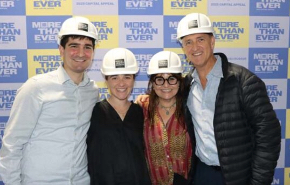
Noa Tishby comforts ‘forgotten’ Bondi survivors

Israeli author, actor and activist Noa Tishby has told survivors of the Bondi terror attack that their trauma is real and that they are part of a global Jewish community that felt the shock of December 14.
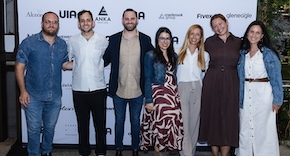
Tishby spoke to a morning gathering of around 100 survivors at Mizrachi Synagogue on February 13, in an event organised by Shoshana Eisner of Operation Golda. Those present included people who had been at the Chanukah celebration next to Bondi Beach when gunfire erupted, some shielding children and strangers as shots rang out. There were around 350 people at the celebration or nearby during the terror attack.

The visit was also personal. Tishby told the group she had lived for several years on Campbell Parade in Bondi and knew the beachfront well. Waking on the first night of Chanukah to news of the attack, she said she was overwhelmed.
“I woke up on the morning of the first candle of Chanukah, and I started seeing the text messages coming in. I saw the words “Bondi Beach” and “massacre”, and I was completely devastated,” she said. “I just wanted to come.”
Eisner noted that several of those in the room had not been physically injured but continue to struggle with the psychological aftermath. Because they were not wounded, many had received comparatively little attention from the community, media or government. Tishby addressed that reality directly.

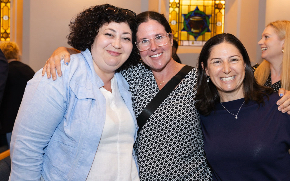
Noa Tishby with survivors of the Bondi terror attack
“You deserve support,” she said. “Even if your story is not on the front page. Even if you walked away physically unharmed. Trauma doesn’t work like that.”
She spoke about the way trauma lingers in the body.
“Your nervous system remembers,” she said. “Even if the headlines move on, your body knows what happened.”
During a question-and-answer session, survivors asked how to move forward after experiencing violence at close range. Tishby acknowledged that recovery is neither simple nor immediate, urging those present to recognise the legitimacy of their reactions rather than dismiss them.
She described the attack as something Jews around the world instinctively recognised.
“Every single Jew around the world knew exactly what this was instantly,” she said. “When you heard the gunshots in Bondi, did you think for a second that it was random? People just knew.”

Noa Tishby talking to survivors of the Bondi terror attack
One young woman said she struggled with how to describe herself, unsure whether she was a victim or a survivor because she had not been physically injured, even though she had heard the gunshots and feared for her life. Tishby answered her gently but firmly.
“You are all survivors,” she said. “You were there.”
She rejected the idea that only those who were wounded could claim that language. “Even if you walked away physically unharmed,” she reminded the room, “trauma doesn’t work like that.”
Looking directly at the young woman and then around the synagogue, she added, “That matters. Your experience matters.”
She said the events at Bondi reverberated globally, reflecting what she described as a deep thread of Jewish peoplehood that connects communities across continents. She said messages of concern and solidarity had poured in from around the world in the hours and days after the attack.
Drawing a parallel with the October 7 atrocities in southern Israel, Tishby said that day had already altered Jewish consciousness worldwide. In her view, Bondi was not an isolated shock but part of a broader climate in which antisemitism had become more visible. She said October 7 had stripped away a sense of complacency and reminded many Jews that antisemitism is not confined to history.
“We are the canary in the coal mine,” she said. “When something starts going wrong in a society, it usually starts with the Jews.”
Describing antisemitism as a “shape-shifting conspiracy theory”, she said it adapts to the language of each era while recycling familiar accusations.
“It’s the same story in a different outfit,” she said. “The language changes. The target stays the same.”
In response to questions about public rhetoric and the wider debate, Tishby said there must be moral clarity when Jews are targeted, arguing that ambiguity only deepens confusion. She warned against what she described as moral inversion, where violence against Jews is contextualised rather than clearly condemned.
Asked whether the current climate would improve, she pointed to the long arc of Jewish history.
“Jewish history is not a straight line,” she said. “It goes up and down. But we are still here.”
She also addressed concerns about visibility, saying she personally refuses to be ashamed of her identity and encouraging others not to retreat from Jewish life in response to hatred.
“I refuse to be ashamed of being Jewish,” she said.
She also urged those present not to allow fear to dictate how visibly Jewish they choose to live their lives.
One young woman said she struggled with how to describe herself, unsure whether she was a victim or a survivor because she had not been physically injured, even though she had heard the gunshots and feared for her life. Tishby answered her gently but firmly.
“You are all survivors,” she said. “You were there.”
She rejected the idea that only those who were wounded could claim that language. “Even if you walked away physically unharmed,” she reminded the room, “trauma doesn’t work like that.”
Looking directly at the young woman and then to the others in the room, she added, “That matters. Your experience matters.”
As the morning drew to a close, she returned to the emotional reality in the room, acknowledging the weight carried by those who had been present during the attack.
“You were there,” she said. “That matters. Your experience matters.”
Her final message was direct.
“You are part of a people that knows how to survive,” she said. “You are not alone in this.”