Building a future of peace and cooperation for Jewish life in Western Sydney

Parramatta and District Synagogue has marked a historic turning point for Jewish life in Western Sydney, bringing together the legacy of the Bankstown and Strathfield communities into a single centre.
About 120 people attended a special event on March 15, which formally recognised the establishment of the Greater Western Sydney Jewish Cultural Centre and the continuation of Jewish communal life in the region. The event united the histories of the Bankstown and Strathfield congregations within Parramatta and District Synagogue, creating a single centre for Jewish life in Western Sydney.

Rabbi Roni Cohavi, Michael Morris, and Max Lewis, the grandson of Bernard Lewis (l to r), unveiling the foundation stone from Bankstown in the background (photo supplied)
“This represents the beginning of a new chapter for Jewish life in Western Sydney,” Rabbi Roni Cohavi told JWire. “We are carrying forward the legacy of the Bankstown and Strathfield synagogues and uniting their histories into one centre.”
Jewish life in Western Sydney has developed over decades through communities in Bankstown, Strathfield and Parramatta, reflecting the broader spread of Jewish families across Sydney’s suburbs over the past century.
Bankstown Synagogue, established in 1913 and one of the earliest suburban synagogues in Sydney, was destroyed in an arson attack in 1991. The attack formed part of a series of antisemitic synagogue fires across Sydney that year and ultimately led to the closure of the Bankstown congregation, whose members dispersed to other communities.
The Strathfield congregation continued for some years but was ultimately closed in the early 2000s as the local Jewish population declined, and the premises were later sold.
Parramatta and District Synagogue is now the only remaining synagogue in the region.
Rabbi Cohavi said the transition reflected continuity through change, ensuring that while earlier communities had closed, their legacy would continue in a new form. Proceeds from the sale of the Bankstown and Strathfield properties helped modernise the synagogue’s facilities, allowing Jewish communal life in Western Sydney to continue and expand.
The ceremony centred on the unveiling of several items from Bankstown Synagogue, including a wooden pew that survived the fire.
The bench originally stood on the southern side of the synagogue and formed part of the front row arrangement. It was associated with the Broit and Schaher families, whose name plates remain affixed to the wood.

The restored pew from Bankstown synagogue (photo: supplied)
After the fire, the bench was sold to a second-hand shop in Queensland before being recognised and identified through the name plates. It was later returned to Sydney and restored over four years, with members of the family attending the event.
Also unveiled at the ceremony was the original foundation stone of Bankstown Synagogue, which had been in storage for more than 30 years before being brought to Parramatta. It was unveiled by Max Lewis, grandson of Bernard Lewis, one of the synagogue’s pioneers.
Established in 1913, the synagogue’s early history is reflected in the stone, which bears Bernard Lewis’s name and those of other founding members. The stone has now been installed in the synagogue foyer.
A sandstone Ten Commandments tablet, also saved from the fire, was restored after being badly damaged. Missing brass letters were recreated and inserted during the ceremony by a descendant of one of the original families.
Several speakers addressed the gathering, including community members connected to the Bankstown congregation.
Alongside the historical elements, the event also highlighted the growth of the Greater Western Sydney Jewish Cultural Centre, which has developed into a broader hub for education, culture and community engagement.
Rabbi Cohavi paid tribute to local businessman Vincent Uno, who played a key role in shaping that development. Initially approached to assist with compliance requirements, he identified the potential for a much larger initiative.
Drawing on his professional background in accounting, Uno proposed a model that would integrate learning, community activity and multicultural engagement. He later developed and presented a structured business plan, working closely with Rabbi Cohavi, Rebbetzin Michal and Parramatta and District Synagogue president Michael Morris to establish and grow the centre.
When the centre was established in 2024, Uno said its purpose was grounded in education.
“[Antisemitism] stems from a lack of education, hence the reason why we’re trying to build a library, so the uneducated can educate themselves before forming an opinion,” he said.
Rabbi Cohavi said the centre was designed to reach beyond those who attend synagogue services.
“There are many people who want to connect to their Jewish identity, but not necessarily through prayer,” he said. “So, we created a space for culture, education, dialogue and social connection.”
Western Sydney is one of the most multicultural regions in the country, and Rabbi Cohavi said a central aim of the centre is to build meaningful relationships across communities and encourage dialogue between different faiths and cultures.

Joshua Lewis inserting the missing letters into the Ten Commandments tablet, which was saved from the arson attack on the Bankstown Synagogue. Joshua is the son of Max Lewis and the great-grandson of Bernard Lewis. (photo supplied)
The centre has already hosted interfaith initiatives and attracted participants from a wide range of backgrounds. Invitations have also been extended to community leaders across local, state and federal levels, including through small Shabbat gatherings that offer a direct experience of Jewish life and tradition.
Rabbi Cohavi said interest from the broader community had grown following the October 7, 2023 Hamas attacks and, more recently, after the Bondi terror attack on 14 December, with many non-Jewish residents seeking to learn more and show support.
“In light of these difficult moments, our response is to strengthen connections between communities and reaffirm our shared humanity,” he said.
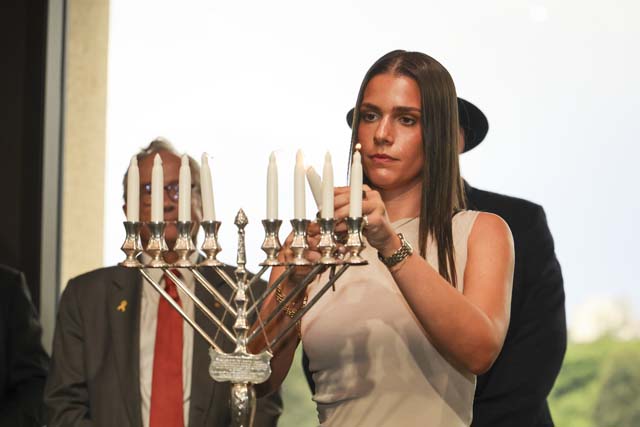
As part of the event, the synagogue also dedicated an extension of its library in memory of the victims of the Bondi attack. The original library had been dedicated to the victims of October 7, with both now forming part of the same commemorative space.
Rabbi Cohavi said the centre is intended to serve as a shared space for learning, connection and cultural exchange across Western Sydney.
“We are not just preserving history,” he said. “We are building a future of peace, harmony and cooperation.”