Jewish and Catholic students explore antisemitism at Nostra Aetate anniversary forum

Jewish and Catholic high school students from across Sydney have come together to mark 60 years since the Vatican’s historic declaration Nostra Aetate, in a special forum aimed at deepening understanding and countering antisemitism.
Nostra Aetate, promulgated on October 28, 1965, by Pope Paul VI during the Second Vatican Council, marked a transformative moment in Christian-Jewish relations. It was the Catholic Church’s first formal denunciation of “hatred, persecutions and displays of antisemitism directed against Jews at any time and by anyone”, while affirming the “spiritual patrimony common to Christians and Jews”; a seismic shift from centuries of what French historian Jules Isaac called a “teaching of contempt” towards the Jewish community.

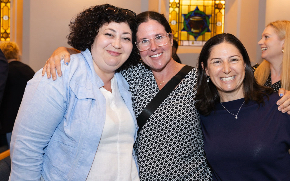
Jewish and Catholic students at school forum
The landmark event at Australian Catholic University’s (ACU) North Sydney campus brought together 125 students from 15 schools, organised by Catholic Education NSW and the Executive Council of Australian Jewry (ECAJ). It featured two leading figures in interfaith dialogue: Australia’s Special Envoy to Combat Antisemitism, Jillian Segal, and Chaldean Archbishop Amel Nona, chair of the Australian Catholic Bishops Conference Commission for Christian Unity and Inter-religious Dialogue.
Archbishop Nona was exiled from Mosul, Iraq by Islamic State in 2014 before resettling in Sydney, where he was installed as Bishop of the Chaldean Catholic Diocese of St Thomas the Apostle of Australia and New Zealand in 2015.
Students posed probing questions to a panel of Jewish and Catholic leaders that included Catholic Schools NSW chief executive officer Dallas McInerney, ECAJ co-CEO Peter Wertheim, Chief Rabbi of the Great Synagogue Benjamin Elton, Catholic educator Dr Paul O’Shea, and Catholic Religious Australia justice research officer Emma Carolan.

Jillian Segal speaks to students with ACU’s Fr Gerald Gleeson (supplied)
Topics ranged from the distinction between anti-Zionism and antisemitism to the role of social media in spreading hate, and whether interfaith dialogue has changed since the Hamas attacks of 7 October 2023. Drawing on the students’ insights, ACU’s Ancient Israel Programme, which is Australia’s only university course devoted to the archaeology and history of ancient Israel, will develop new digital teaching materials to help Catholic schools across New South Wales recognise and respond to antisemitism.
Earlier this year, Segal, Special Envoy for Antisemitism, launched Australia’s national plan to combat antisemitism. She told students that education was the cornerstone of her approach.
“Education is a central part of my plan, both at universities and at schools,” she said. “It is the main tool that is available to us all to tackle antisemitism proactively and for the next generation of leaders. There is a sacred duty for educators to inform themselves about antisemitism, its nature and history, so they can make a positive impact and help repair Australia’s social cohesion.”
Wertheim echoed that sentiment, saying the initiative filled an urgent gap.
“In combatting antisemitism, there is no substitute for the hard, proactive work of ‘educating the educator’ about the history, forms and adaptability of antisemitism,” he said. “If the resources developed by Jewish and Catholic educators prove effective, they can be rolled out more widely to schools across Australia.”
Archbishop Nona reflected on Nostra Aetate’s moral legacy, describing it as a spiritual turning point in Christian–Jewish relations. “To follow Christ means to reject hatred in any form, but especially against Jews,” he said.
The forum, an initiative of ACU’s Associate Professor Gil Davis, Director of the Ancient Israel Programme, and Catholic Schools NSW Head of Mission Ben Smith, marked a renewed commitment by both communities to dialogue, respect and education.
ACU and Catholic Schools NSW plan to continue their collaboration, developing resources and fostering interfaith understanding to ensure Nostra Aetate’s message of reconciliation and shared humanity endures for future generations.