From Kristallnacht to Kindertransport: Sydney commemoration unites generations of hope

Last night, close to 800 people gathered in Sydney for the NSW Jewish Board of Deputies’ annual Kristallnacht commemoration, an evening that powerfully linked a notorious moment of the Nazi pogrom with the subsequent act of rescue. The event, themed “From Kristallnacht to Kindertransport”, was a moving reflection on memory, compassion, and resilience.
Dane Stern, chair of the Shoah Remembrance Committee, captured the evening’s duality, saying, “Out of the ashes of Kristallnacht came an extraordinary act of light, the Kindertransport,” reminding attendees that courage can emerge even in despair. Kristallnacht saw over 200 synagogues burned and 7,000 Jewish businesses vandalised in November 1938, leading directly to the British effort that saved nearly 10,000 Jewish children.

Producer Emile Sherman in conversation with Michaela Kalowski (Giselle Haber)
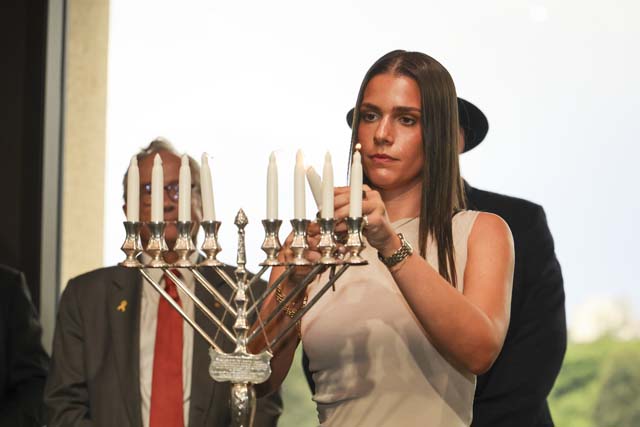
One of the most emotional segments was the candle lighting ceremony, honouring six people saved on the Kindertransport. Survivors or their descendants lit the memorial candles. Each candle lighter was accompanied by a child the same age as the Kinder when they escaped Europe. Dane noted that the sight of the frail survivors standing alongside young children was a potent reminder that the rescue was a story of “childhood interrupted”.
Two of the Kinder, Marion Paul and Susie Stuby, both aged 95, attended and lit candles themselves. Ms Paul, who was eight when she said her final goodbye to her parents, arrived in Melbourne in 1939 with her sister on a Kindertransport organised by the Australian Jewish Welfare Society. Ms Stuby was told she was going on a “short holiday”, travelled alone from Vienna, and never to see her parents again.

Marion Paul and Yasmin Patterson (Giselle Haber)
The ceremony also honoured the late Rita Newell, who fled Cologne on her 12th birthday, just one week after Kristallnacht, and Regina Merkur, a former Enigma codebreaker who joined the Kindertransport aged 14. The daughter of Rosa Hausmann, Sandra Hogan lit a candle for her mother, who celebrated her 102nd birthday in Brisbane last month.
Academy Award-winning producer Emile Sherman was the keynote speaker, focusing on his film “One Life”, which chronicles Sir Nicholas Winton’s rescue efforts in saving 669 Jewish children. Sherman, who won an Oscar for “The King’s Speech” and produced “Lion”, was interviewed by Michaela Kalowski.
The producer shared insights into Winton’s moral courage and the responsibility to act in the face of indifference. He detailed the process of making “One Life”, including the story of meeting Winton when the humanitarian was over 100 to ask permission to tell his story.
Sherman revealed a powerful detail about the film’s production. For the recreation of Winton’s famous reunion on the “That’s Life” programme, the people seated in the audience were not random extras. They were the children of the Kinder that Winton had saved, a decision made to ensure the scene held deep personal relevance for every person in the room.
Following Sherman’s address, Helen Geedrick shared her father’s Kindertransport story, which directly linked to Winton. Geedrick discovered her father, Peter Sprinzels, was one of the children Winton rescued when she found his original 1939 Kindertransport tag among his possessions in 2011.

Peter Sprinzel’s Kindertransport tag (Helen Geedrick)
Her father’s journey from Prague was personally arranged by his own father with Sir Nicholas Winton. She detailed her emotional meeting with Winton in 2015, where she thanked him for saving her father’s life. Winton’s humble reply, “Well, someone had to do it,” underscored the impact of his quiet decency.
A tribute was also paid to the late Yvonne Engelman for her decades of Holocaust education, with her granddaughter, Naomi Raiz, giving a powerful speech. The memorial prayers, including “El Malei Rachamim” recited by Ezry Israel and “Kaddish” by Rabbi Jeffrey Kamins, whose father-in-law was a Kindertransport survivor, concluded the solemn part of the evening. The event was well-supported by government, with federal and state parliamentarians, diplomats, and local government leaders among the attendees.
Musical performances throughout the evening were deeply poignant. Ben Adler and Paul Khodor performed Elena Kats-Chernin’s beautiful piece, “The Night of Broken Glass”, which the composer wrote as a response to the events of Kristallnacht.
The Yiddish lullaby, “Rozhinkes mit Mandlen” (Raisins and Almonds), was performed over a montage of Kinder images, a tender tribute to the parents who sent their children away for a safe future. The commemoration culminated in a moving performance of “Close Every Door” from Joseph by the musicians and a combined children’s choir accompanied by Ezry Israel. The final line of the song “For we have been promised a land of our own” was particularly poignant and led directly into the singing of “Hatikvah”.
As the audience proudly sang “Hatikvah”, the message felt unmistakable: even through darkness, hope and humanity endure. The evening closed not only as a remembrance of loss but also as a quiet affirmation of resilience and hope.